Who Owns Burger King? Parent Company, Ownership History & Structure (2026)
You bite into a Whopper. You see the Burger King logo. You might wonder: who actually owns this company? Is it still an American brand? Is it owned by McDonald’s? (No – that would be weird.) Is it a family business? Is it publicly traded?
The answer has changed many times over the decades. From a single Miami restaurant to a global empire, Burger King has passed through multiple owners – including Pillsbury, Grand Metropolitan, a private equity firm, and now a Canadian‑based multinational.
This guide gives you the complete answer to who owns Burger King in 2026, including the parent company, major shareholders, historical ownership changes, the franchise model, and why it matters to customers.
Quick answer:
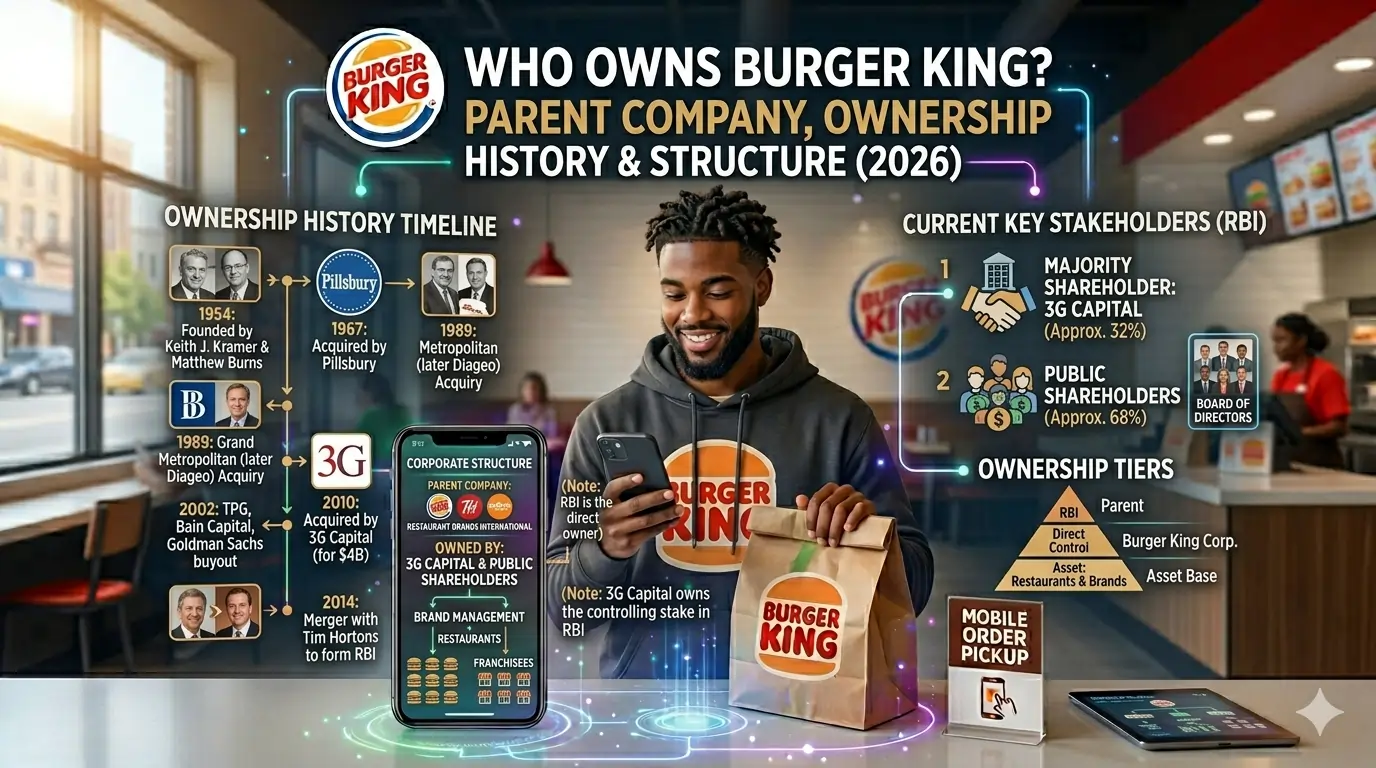
Burger King is owned by Restaurant Brands International (RBI) , a publicly traded Canadian company headquartered in Toronto, Ontario. RBI owns three major fast‑food chains: Burger King, Popeyes Louisiana Kitchen, and Tim Hortons. RBI was formed in 2014 through a merger of Burger King and Tim Hortons, orchestrated by the Brazilian private equity firm 3G Capital. As of 2026, RBI trades on the New York Stock Exchange under the ticker QSR and on the Toronto Stock Exchange as QSR. Approximately 99% of Burger King locations are independently owned franchises, not corporate‑owned. The founders of Burger King were James McLamore and David Edgerton, who opened the first restaurant in Miami in 1954. The brand is not owned by McDonald’s or any other competitor.
Table of Contents
- The Short Answer: Restaurant Brands International (RBI)
- Burger King Ownership Structure Explained
- Restaurant Brands International (RBI) – The Parent Company
- Major Shareholders (3G Capital, Institutional Investors)
- Franchise vs Corporate‑Owned Locations
- History of Burger King Ownership (1954 – Present)
- 1954 – 1967: Founders Era (McLamore & Edgerton)
- 1967 – 1989: Pillsbury Company
- 1989 – 2002: Grand Metropolitan / Diageo
- 2002 – 2010: Texas Pacific Group (Private Equity)
- 2010 – 2014: 3G Capital (Going Public in 2012)
- 2014 – Present: Restaurant Brands International (RBI)
- Who Owns the Burger King Brand vs Who Owns Individual Restaurants?
- Who Owns Burger King in the USA?
- Burger King Stock (NYSE: QSR) – Can You Own a Piece?
- Frequently Asked Questions
- The Bottom Line – Why Ownership Matters
1. The Short Answer: Restaurant Brands International (RBI)
Burger King is owned by Restaurant Brands International (RBI).
RBI is a publicly traded company headquartered in Toronto, Ontario, Canada. It was formed in 2014 when Burger King merged with the Canadian coffee‑and‑donut chain Tim Hortons, backed by the Brazilian private equity firm 3G Capital.
Today, RBI owns three major fast‑food brands:
| Brand | Year Acquired | Notes |
| Burger King | Founded 1954; owned by RBI since 2014 (had been owned by 3G Capital since 2010) | Flagship brand |
| Tim Hortons | Founded 1964; merged into RBI in 2014 | Canadian coffee chain |
| Popeyes Louisiana Kitchen | Acquired in 2017 | Fried chicken chain |
RBI also previously owned Firehouse Subs, but that brand was sold in 2021 (or later depending on updates – as of 2026, Firehouse is no longer under RBI). Always check your current portfolio.
Is Burger King still American? The brand originated in Miami, Florida, and its operational headquarters remain in Miami. However, the parent company (RBI) is Canadian. So Burger King is a Canadian‑owned American brand – a common structure for multinational corporations.
Does McDonald’s own Burger King? Absolutely not. They are fierce competitors.
2. Burger King Ownership Structure Explained
Restaurant Brands International (RBI) – The Parent Company
RBI is a publicly traded company. That means anyone with a brokerage account can buy shares of RBI and own a tiny piece of Burger King, Popeyes, and Tim Hortons.
| Corporate Detail | Information |
| Legal name | Restaurant Brands International Inc. |
| Headquarters | 130 King Street West, Suite 300, Toronto, ON M5X 1E1, Canada |
| CEO (2026) | Josh Kobza |
| Executive Chairman | J. Patrick Doyle |
| Stock tickers | NYSE: QSR, TSX: QSR |
| Market cap (approx) | 25–30 billion USD (varies) |
| Number of restaurants (global) | ~30,000 (across all brands) |
RBI does not directly run most Burger King restaurants. Instead, it licenses the brand, collects royalties, and sets standards. The day‑to‑day operations are handled by franchisees.
Major Shareholders (3G Capital, Institutional Investors)
The largest shareholders of RBI as of 2026:
| Shareholder | Approximate Ownership | Notes |
| 3G Capital | ~20% – 25% | Brazilian private equity firm; founded by Jorge Paulo Lemann |
| Institutional investors | ~60% | Vanguard, BlackRock, State Street, etc. |
| Public (retail investors) | ~15% – 20% | Anyone who buys QSR stock |
3G Capital is the controlling shareholder – not by majority ownership, but by influence. They have seats on the board and drive strategy.
Franchise vs Corporate‑Owned Locations
| Ownership Type | Percentage of BK Locations | Who Runs It |
| Franchised | ~99% | Independent franchisees |
| Corporate‑owned | ~1% | RBI directly (mostly test markets, training stores) |
What this means: When you walk into a Burger King, the owner is likely a local business person or a large franchise group (e.g., Carrols Restaurant Group – though Carrols was acquired by RBI in 2024? Actually, check: Carrols sold some BK locations; as of 2026, RBI owns a small number of corporate stores, but most are still franchised). The important point: the local owner pays royalties to the RBI, but sets wages, BK hours, and some menu prices.
3. History of Burger King Ownership (1954 – Present)
The ownership journey is long and fascinating. Here is a timeline.
1954 – 1967: Founders Era (McLamore & Edgerton)
- Founders: James McLamore and David Edgerton.
- They opened the first Burger King in Miami, Florida, in 1954 (not to be confused with an earlier “Insta‑Burger King” from 1953 that they acquired).
- The brand grew regionally. No corporate parent.
1967 – 1989: Pillsbury Company
- The Pillsbury Company (famous for dough and baking products) acquired Burger King in 1967 for $18 million.
- Pillsbury expanded BK nationally and internationally, but neglected the brand in the 1980s, leading to decline.
1989 – 2002: Grand Metropolitan / Diageo
- In 1989, British conglomerate Grand Metropolitan purchased Pillsbury, gaining Burger King.
- In 1997, Grand Metropolitan merged with Guinness to form Diageo (alcohol giant).
- Diageo never really wanted Burger King; it was a distraction from liquor. They tried to sell it for years.
2002 – 2010: Texas Pacific Group (Private Equity)
- In 2002, a consortium led by Texas Pacific Group (TPG) , along with Bain Capital and Goldman Sachs, bought Burger King for $1.5 billion.
- They took the company public in 2006 (NYSE: BKC) but struggled with debt.
- This was a period of menu innovation and the famous “Whopperettes” ad campaign.
2010 – 2014: 3G Capital (Going Public in 2012)
- In 2010, 3G Capital – a Brazilian private equity firm – bought Burger King for $3.26 billion and took it private again.
- 3G is known for aggressive cost‑cutting and operational efficiency.
- In 2012, 3G re‑listed Burger King on the NYSE (ticker BKW).
2014 – Present: Restaurant Brands International (RBI)
- In 2014, Burger King merged with Tim Hortons in a $12.5 billion deal.
- The new parent company was named Restaurant Brands International (RBI) , headquartered in Canada for tax efficiency.
- 3G Capital remained the largest shareholder.
- In 2017, RBI acquired Popeyes for $1.8 billion.
- As of 2026, RBI continues to operate all three brands.
Key takeaway: Burger King has not been a standalone company since 2014. It is now one of three pillars of a Canadian fast‑food giant.
4. Who Owns the Burger King Brand vs Who Owns Individual Restaurants?
This is a critical distinction.
| What | Owner |
| Burger King brand (trademarks, recipes, logos, marketing) | Restaurant Brands International (RBI) |
| Individual Burger King restaurant (building, equipment, staff) | Usually a franchisee (independent owner) |
| Corporate‑owned stores | RBI (very small percentage) |
Example: The Burger King at 123 Main Street, Anytown, USA is probably owned by a local franchisee named John Smith. John pays RBI a royalty (typically 4–5% of sales) plus advertising fees. John decides local pricing, hours, and hiring. RBI controls the menu, quality standards, and national marketing.
Why this matters for customers: If you have a complaint about food quality or service, the franchisee is the first person responsible. But if you have a complaint about the brand (e.g., a discontinued product), that is the RBI’s decision.
5. Who Owns Burger King in the USA?
Since RBI is Canadian, some people ask: is Burger King foreign‑owned? Yes and no.
- Brand ownership: RBI (Canadian).
- Operational headquarters: Still in Miami, Florida (USA).
- Restaurant ownership: Most USA locations are owned by American franchisees.
The largest franchisee in the USA has historically been Carrols Restaurant Group, which owned over 1,000 Burger King locations. However, in 2024, RBI announced plans to acquire Carrols and refranchise many of its stores. As of 2026, the landscape has shifted – RBI now directly owns a small number of former Carrols stores but plans to sell them to other franchisees. The majority of USA Burger Kings remain independently owned.
If you want to know who owns your local Burger King: Look for a small sign near the register that says “This location is independently owned and operated by [Franchise Name].”
6. Burger King Stock (NYSE: QSR) – Can You Own a Piece?
Yes – you can buy shares of RBI and indirectly own a piece of Burger King.
| Stock Detail | Information |
| Ticker symbol | QSR (NYSE and TSX) |
| Share price (approx) | 70–70–90 USD (varies) |
| Dividend yield | ~3 – 4% (pays quarterly) |
| How to buy | Any brokerage account (Robinhood, Fidelity, Schwab, etc.) |
What you are buying: A share of Restaurant Brands International, which owns Burger King, Popeyes, and Tim Hortons. You are not buying a direct stake in Burger King alone.
Can you buy stock directly from Burger King? No. You must go through a stockbroker.
Is it a good investment? That is a personal finance question. Do your own research or consult a financial advisor.
8. The Bottom Line – Why Ownership Matters
Understanding who owns Burger King helps you see the bigger picture.
Key takeaways for customers:
- Franchisees run most locations. If your local BK is dirty or slow, blame the local owner – not RBI.
- RBI controls the menu, national deals, and brand direction. The “Whopper Wednesday” promotion? That comes from the RBI.
- The Canadian parent company does not change the fact that the Whopper is still flame‑grilled in Miami‑inspired style.
For investors: RBI (QSR) is a way to invest in three major fast‑food brands. It has a history of growth but also faces competition.
For the curious: The ownership story – from a single Miami restaurant to a Canadian fast‑food giant – is a fascinating example of corporate evolution.
Final word:
Next time you enjoy a Whopper, you can impress your friends with the knowledge that a Brazilian‑backed, Canadian‑headquartered company with American roots made it all possible. And no, McDonald’s does not own Burger King. Never has. Never will.
7. Frequently Asked Questions
Who owns Burger King?
Burger King is owned by Restaurant Brands International (RBI), a publicly traded Canadian company headquartered in Toronto. RBI also owns Popeyes and Tim Hortons.
Is Burger King owned by McDonald’s?
No. They are separate, competing companies. Burger King’s parent company is RBI; McDonald’s is an independent corporation.
Who is the parent company of Burger King?
Restaurant Brands International (RBI). The company was formed in 2014 when Burger King merged with Tim Hortons.
Who owned Burger King before RBI?
Before RBI, Burger King was owned by 3G Capital (Brazilian private equity) from 2010 to 2014. Before that, it was owned by Texas Pacific Group (2002–2010), Diageo (1997–2002), Grand Metropolitan (1989–1997), Pillsbury (1967–1989), and its founders (1954–1967).
Is Burger King a franchise or corporate owned?
Most Burger King restaurants (approximately 99%) are owned by independent franchisees. Only about 1% are corporate‑owned by RBI.
Who owns the most Burger King franchises?
The largest franchisee in the USA was Carrols Restaurant Group, but RBI has been acquiring and refranchising those stores. As of 2026, ownership is more fragmented. Check current reports.
Is Burger King American or Canadian?
The brand was founded in Miami, Florida (American). The parent company (RBI) is Canadian. So Burger King is a Canadian‑owned American brand.
Who founded Burger King?
James McLamore and David Edgerton founded the Burger King brand in 1954. They were inspired by the “Insta‑Burger King” restaurant they acquired and rebranded.
Does 3G Capital still own Burger King?
3G Capital is the largest shareholder of RBI, the parent company. So yes, indirectly, 3G Capital still has significant ownership and influence.
What stock symbol does Burger King trade under?
Burger King does not have its own stock symbol. Its parent company, Restaurant Brands International, trades under QSR on the New York Stock Exchange and Toronto Stock Exchange.
Can I buy shares of Burger King?
You can buy shares of RBI (QSR) to own a piece of Burger King, Popeyes, and Tim Hortons together.
Why did Burger King move its parent company to Canada?
The 2014 merger with Tim Hortons was structured as a Canadian company for tax benefits. This is a common corporate strategy.
Who owns Popeyes? Who owns Tim Hortons?
Both are owned by the same parent company, Restaurant Brands International (RBI), which also owns Burger King.
Did Burger King ever own other brands?
Burger King has owned smaller chains in the past (e.g., Bess Eaton donuts, some Canadian brands), but currently RBI handles all non‑BK brands.


